Summary & Key Points
"Côte d’Ivoire records 14,000 traffic accidents each year; in 2023, there were 21,409 victims, and 9,062 emergency response calls were related to traffic accidents."
Côte d’Ivoire records 14,000 traffic accidents each year, with 21,409 victims in 2023; 9,062 of the emergency response calls were related to traffic accidents. Although the rate of traffic accidents in 2023 decreased by 15% compared to 2022, the situation remains serious enough to warrant the attention of society as a whole, particularly all road users.
Aware of its civic responsibility to achieve zero traffic fatalities in Côte d’Ivoire and committed to helping change attitudes through the adoption of responsible driving,the PAC-CI Program Management, in partnership with CIDH Consulting, organized a workshop on professional ethics for employees of the Procurement and Logistics Department. How can PAC-CI Program drivers improve their driving?
From the outset, Mr. Yao, a trainer at OSER, defined professional ethics as: “the set of principles and moral values that enable one to judge whether an action is acceptable or not within the context of professional activities.”Professional ethics help drivers adopt positive attitudes and behaviors that respect traffic laws, their own lives, and the lives of others; prevent “inappropriate” behavior that could harm their profession and the Program; and, if necessary, address such behavior.
According to him, a “good” driver at PAC-CI must fulfill five roles: an administrative role (checking the vehicle’s parts, his own, and those related to his assignments), checking the vehicle’s condition before starting it, handling cargo (avoiding overloading to prevent the vehicle from consuming too much fuel…), acting as a sales representative (maintaining a professional appearance and language, building a relationship of trust with their employer and partners…), and driving responsibly;that is, adopting a preventive, defensive, and fuel-efficient driving style and avoiding aggressive driving.
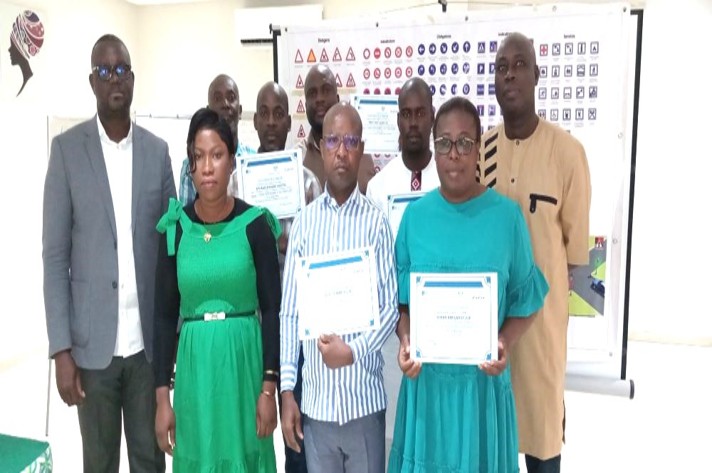
This mastery of rational driving must be reinforced by an understanding of the symbols for hazards, prohibitions, requirements, directions, and services necessary for all road users
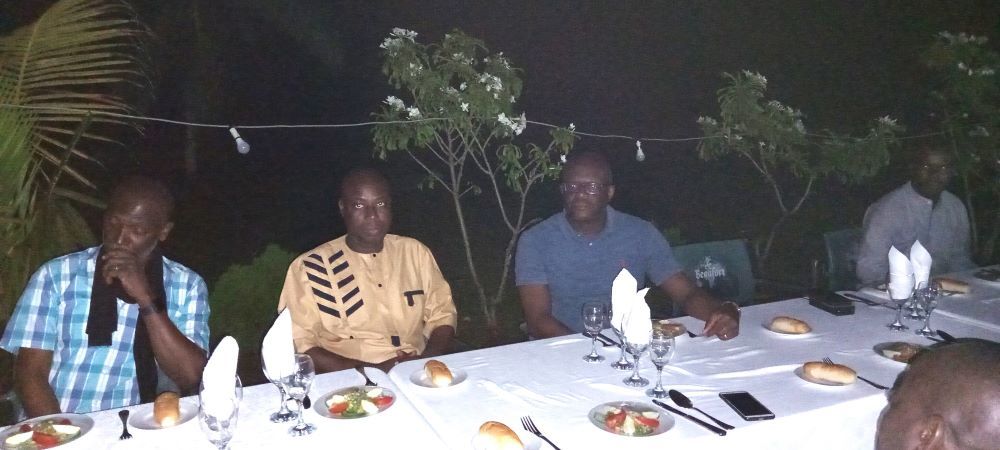
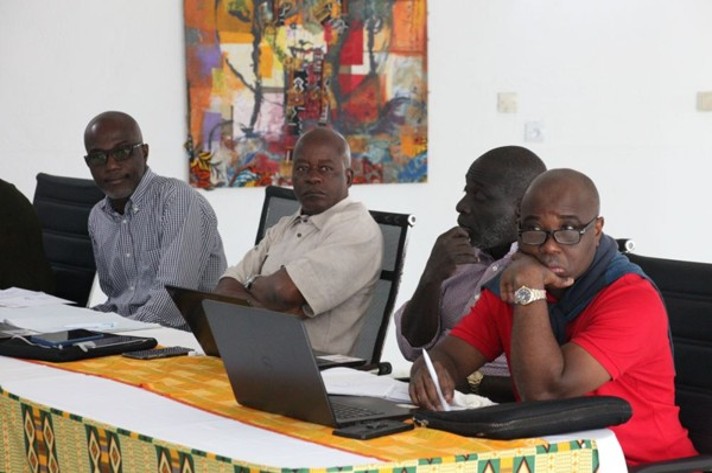
(From left to right) Mr. Konan, Mr. Cissé, Dr. Moh, and Mr. N’chot, during the dinner hosted by management
Aware of their responsibilities toward the PAC-CI Program Management, their relationships with the Program’s partners, and the tasks entrusted to them, the drivers pledged—in the presence of Mr. Cissé, the CFO, Mr. Konan, the Head of Procurement and Logistics, and his assistant, Ms. Konan, to put the trainer’s recommendations into practice both in their work and in their daily lives.
It should be noted that on the evening of the training’s conclusion, Dr. Moh, Executive Director of the PAC-CI Program, traveled to the Floris Hotel to show his support for his staff; he also reiterated management’s commitment to investing in the training of its human capital, with the long-term goal of “making the Program a learning organization.”
PAC-CI
Associate researcher at PAC-CI, contributing to the advancement of scientific research and public health in Côte d'Ivoire.
Contact the author