Summary & Key Points
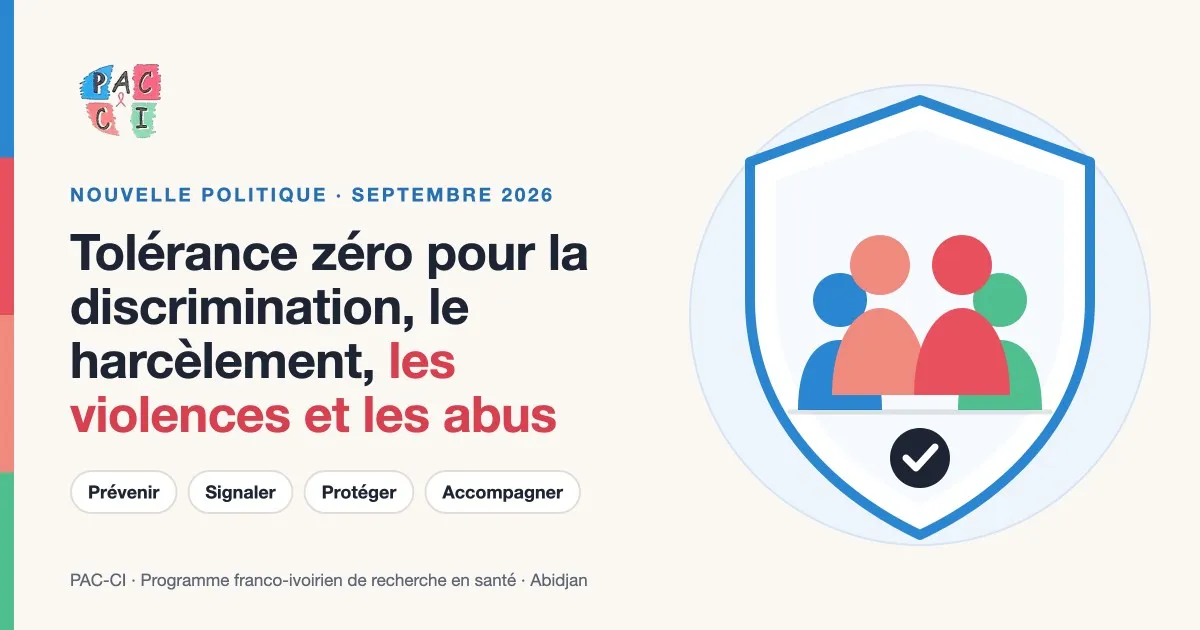
"As of September 1, 2026, PAC-CI has a formal policy for preventing and combating discrimination, harassment, violence, and abuse. This text, adopted by the Executive Board and signed by the Executive Director, Dr. Raoul MOH, reaffirms a simple principle: every person who works with or for PAC-CI must be treated with dignity and respect."
Commitment commensurate with our mission (View source file...)
Since its creation in 1996 through a convention between Côte d’Ivoire’s Ministries of Health and of Economy and Finance, France’s Ministry of Cooperation, and ANRS, PAC-CI has conducted health research in service to populations. Initially focused on HIV/AIDS and infectious diseases, the programme has expanded to include non-communicable diseases, sexual and reproductive health, and now global health.
This mission is carried out by teams of diverse origins and nationalities, working with many national and international partners. To ensure that this diversity remains an asset, a calm, fear-free work environment is essential. The new policy establishes that framework: it defines prohibited behaviors, organizes prevention, and describes how victims are protected and supported.
Who does the policy apply to?
The policy applies to all PAC-CI personnel, regardless of contract type: leaders, managers, central and regional office staff, and employees at all levels. It also covers any person linked to PAC-CI by contract: interns, consultants, subcontractors, suppliers, and service providers. Research participants are likewise covered by its goals of awareness-raising and equitable treatment.
Four clear objectives
- Prevent violence, harassment, and abuse of power in all forms.
- Raise awareness, train, and inform staff, partners, and research participants.
- Maintain a welcoming environment, free of violence, harassment, abuse, and discrimination.
- Ensure fair treatment for staff, partners, and participants.
A solid legal framework
The policy draws on national and international texts:
- the ILO Declaration of 1998 on fundamental principles and rights at work;
- Côte d’Ivoire’s Labor Code (2021), which prohibits employers from considering sex, age, origin, religion, opinions, union activity, HIV status, or disability in decisions. It also protects anyone who refuses to endure harassment or who testifies about it from any sanction;
- Côte d’Ivoire’s Penal Code (articles 418 and 419), which punishes sexual harassment with one to three years’ imprisonment and a fine of 360,000 to 1,000,000 FCFA;
- Order No. 2013-660 on combating corruption, which sanctions abuse of authority aimed at obtaining favors.
What the policy prohibits
The text precisely names the behaviors it forbids:
- Discrimination: treating a person differently because of gender, pregnancy, sexual orientation, age, religion, opinions, language, origin, social status, or disability.
- Abuse of power: pressure, demands for favors, incitement to give false testimony or bypass rules, obstruction of a colleague’s work.
- Psychological and moral harassment, including cyber-harassment: belittling, contempt, degrading remarks. A single serious act may suffice to constitute harassment.
- Sexual harassment: remarks, persistent advances, touching, promises or threats tied to sexual favors.
- Sexual assault: any sexual act committed without free and informed consent.
- Physical violence, including against property.
- Stigmatization: assigning a negative image to a person because of a real or presumed characteristic.
Prevention first
For PAC-CI, prevention is the cornerstone of the system:
- Information on arrival: an informational sheet is given to each new employee, partner, intern, or student, supplemented by an oral presentation during onboarding.
- Posters and video capsules on awareness, reporting procedures, and victim support.
- Mandatory online training, with certification, for every employee. Abuse of power is regularly included in continuing education programs.
- Formal adherence: every concerned person signs the internal rules, which incorporate the policy. This is a prerequisite for any collaboration.
Reporting an incident: a clear, protective procedure
Because prevention cannot eliminate all risk, the policy provides a single reporting and handling procedure:
- Dialogue: if possible, the person who feels victimized first discusses the matter directly with the person accused. They may be accompanied by a member of the Mediation Committee.
- Written complaint: if dialogue fails, a written complaint is submitted in a sealed envelope to the Human Resources service. It is logged with a tracking number and forwarded to the Executive Directorate.
- Mediation Committee: this five-member committee (two members of the Board of Directors, one representative of staff delegates, one member of the social service, and one member of the complainant’s service) checks for conflicts of interest and reviews the complaint’s admissibility.
- Amicable resolution: mediation is offered first. If either party refuses, an investigation is opened.
- Impartial, confidential investigation: testimonies, documents, written or electronic exchanges are examined. The absence of a direct witness or physical evidence does not suffice to dismiss an allegation. Each investigation is reviewed by Internal Audit.
- Findings: Human Resources communicates the findings to the parties and implements the proposed measures. The report remains confidential.
Anonymous reporting. A secure online form will allow facts to be reported without revealing identity (except in cases of harassment, which require identification of the persons involved).
Protection against retaliation. The complainant is protected against any retaliation, even if the complaint is not substantiated.
External recourse. If in doubt, anyone may also contact Côte d’Ivoire’s National Directorate of Labor Inspection (Plateau, Tower A, 11th floor, Abidjan; tel. +225 27 20 21 08 87 / 27 20 22 25 96 / 27 20 21 12 47).
Shared responsibility
The policy clearly assigns roles. The Board of Directors approves it and oversees its implementation. The Executive Directorate disseminates it, applies it, and is accountable for handling allegations. The Human Resources service regularly assesses risks and the effectiveness of measures, consulting staff delegates. The Mediation Committee submits an annual activity report.
Everyone also has a role: employees and partners are urged never to tolerate or allow situations of discrimination, harassment, or abuse to persist, and to report them when witnessed.
In brief
With this policy, PAC-CI affirms that the quality of health research depends on the quality of human relations. No form of violence, discrimination, harassment, or abuse is accepted or tolerated. The policy took effect upon adoption by the Board of Directors and may be revised as needed, via proposals submitted to the Human Resources service.
For any questions or to report a situation, contact PAC-CI’s Human Resources service.
Christian Kouadio
Clinical Research Associate and Communications Manager at PAC-CI
Contact the author